
Mindset Is Trainable. I’m A Case Study.
I decided to interview every athlete on the 2026 U.S. Olympic and Paralympic Team. All 304. From the 5x Paralympic gold medalist to the Olympian making their debut. It’s the first ever full-team solo interview mission in history.
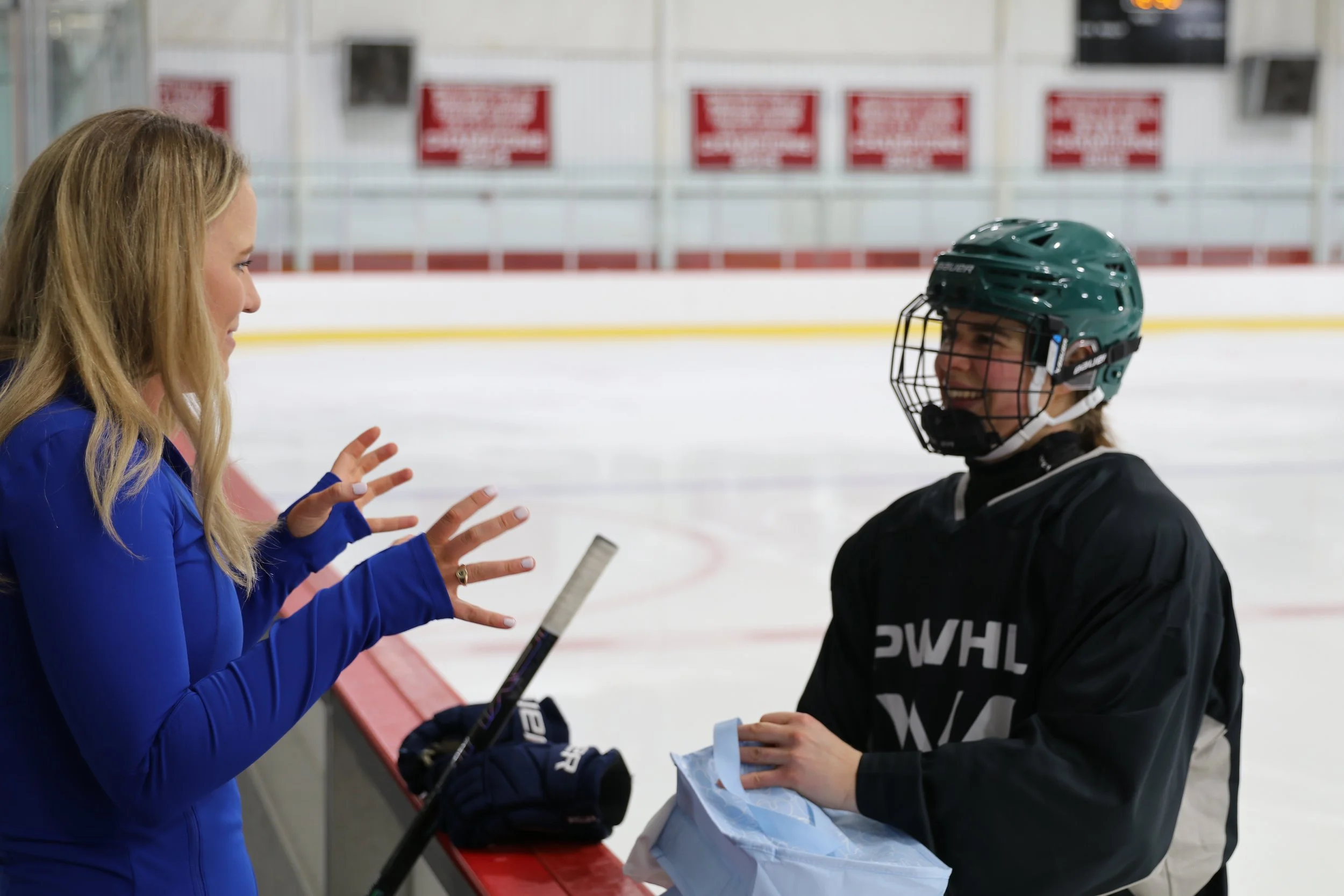
Initially, the goal sounded reasonable in my head and insane out loud. I had no press credentials, no industry contacts, no roadmap for how you get 304 of the most in-demand people in the country to go from “Who’s Amy Wotovich?” to “Oh, she interviewed 100% of Team USA”. What I had was grit, self-belief, and a long-term goal.
Photo Credit: Back The Team
I'm telling you this not because I’m seeking external validation that this goal is lofty and the mission is impressive (I'll let the finished outcome speak to that 👀). I’m sharing this because around interview 150, I realized I have become a case study myself.
The premise of this whole mission is that mindset is trainable. It’s not a fixed trait you either have or don't, but rather a muscle. My hypothesis is that you can build your mindset the same way physical strength is built, through repeated, deliberate, often uncomfortable reps.
I began to hear a version of this hypothesis in nearly every conversation. But I didn’t expect that I'd spend the next year training my own mindset muscle.
Unlike the athletes I’m speaking to, fear doesn’t show up for me on a start line. It shows up in attending a press conference for the first time and weaving through a crowded room to a hot mic to ask a question. It shows up in the mixed zone (with my iPhone) and meeting Team USA content creators on my left and the NBC production team on my right (with cameras so fancy I can’t even pronounce the model). It shows up in consistently asking a 14-time Paralympic medalist for fifteen minutes of her time and hearing nothing back for three months.
Failure didn't show up as a fall or a missed gate. It showed up in the weeks where progress felt nonlinear (or even backwards) and I had to decide whether to keep going anyway.
For me, pressure showed up as an interview number I'd made public (304) that I had no guarantee I could actually hit, and a growing audience watching whether I would.
While I’m not chasing a berth to the Games myself, in chatting to those who have, I’ve trained my mindset from the world’s best by getting uncomfortable on purpose, repeatedly, for a long-term bet on myself.
I think this is the proof. If mindset is genuinely trainable, then the most honest way to demonstrate that isn't to point at 304 elite athletes and ask you to take my word for it. It's to use the exact same muscle to do something audacious too.
Now that I am certain that mindset is a trainable muscle, I am sitting with an even deeper question that I cannot shake. How can we measurably quantify how our mindset gets stronger?



ABOUT THIS SERIES
I'm Amy Wotovich and I’m on a mission to personally interview 100% of the 2026 U.S. Olympic and Paralympic Team. How do elite athletes train their mindset, overcome failure, sustain dominance, and compete with confidence? All 304 athletes are sharing their unfiltered answers. Follow @backtheteam to level up your mindset alongside the world’s best.
