
A Loss Is Only a Failure If You Learn Nothing. Conor McDermott-Mostowy Wrote That Quote After Living It.
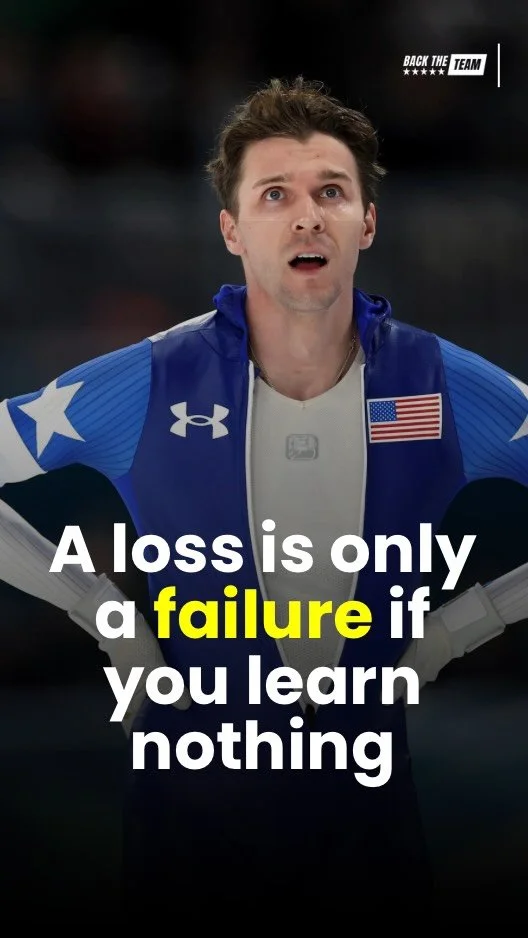
“A loss is only a failure if you learn nothing from it.”
That line is sitting in Conor McDermott-Mostowy's Instagram bio right now. He wrote it himself after getting norovirus right before the 2022 Olympic Trials and missing the Games.
"I needed to listen to that advice myself when I did not make the Games. I was absolutely devastated. Before getting sick, I thought I was a definite shoe-in to make the team."
The quote became a reminder of a lesson he had learned the hard way.
Not a Child Prodigy
Conor was not an exceptional speed skater growing up. He’ll be the first to say it.
“I was not a prodigy.”
He worked with his first two coaches for eight years throughout the entirety of his entire short track career. They saw everything: the losses, the plateaus, and the races that didn't go his way. And both of them, separately, have since told him the same thing.
"They essentially told me I was not the person they had pegged to go to the Olympics."
One of those coaches was a Korean Olympian. In Korea, speed skating is the sport which created a system where, as Conor describes it, it’s sink or swim from an early age. If you can't keep up, you're out. There are hundreds waiting to take your place.
She watched Conor lose. A lot. And she watched something else too.
"She said my work ethic, and my parents' support of me when I was young…I mean I lost so many races as a kid… changed the way she thought about coaching and who could be successful."
Conor didn’t have the positive reinforcement of winning. His drive came from within.
"All my drive to keep skating had to be intrinsic. I had to love the sport and I had to love the pursuit of getting better. I learned that the only person you need to be competing against is yourself. You just want to be better than you were before. And eventually, if you can maintain those two things, the results on paper will follow."
Two decades later, he made his Olympic debut at the Milano Speed Skating Stadium. The coaches who didn't peg him as a future Olympian were right about a lot of things. They just weren't right about that.
Learning from the Losses
He did short track for eight years. Then long track for eight more. Sixteen years of competition equates sixteen years of losses: fourth-place finishes, missed qualifications, races that slipped away. And certainly a few wins too. Conor is among the best in the world. But the losses? He cataloged them as data.
"A loss is only a failure if you learn nothing from it. Every single loss, every last-place finish, every fourth-place finish — you need to look at that and be like: okay, what can I do to be better next time?"
The year before the Olympics was one of the roughest of his career. With health issues he couldn't train through, his times and placements began to fall off. The harder he pushed, the worse he got, because his body couldn't recover and adapt. Eventually the only fix was to stop skating entirely for a stretch, mid-season.
Going into the Olympic year, he had no idea what to expect. But at a World Cup in Norway early in the season, he posted his best placement in two or three years. He got emotional on the ice.
"It was such a moment. I genuinely did not know if I was going to be able to skate at that level again."
He made the 2026 U.S. Olympic team. He performed, by his own measure, right in line with his World Cup performances going in.
"I tried to just approach the competition itself like any other competition I've ever been to. And then enjoy everything else surrounding the Olympics. You know, when I stepped on the rink, I just remember thinking to myself: I've done this a thousand times. I know what I'm doing."
His self-belief was built over sixteen years of treating every result (win or loss) as a learning opportunity.
Lose to Level Up
You are probably not going to compete in long track speed skating. But at some point in near future, you are going to fall short of a goal. A goal you set for yourself, or one that someone else placed on you.
Conor's question is worth borrowing: what did you learn from it?
Not every loss becomes a lesson automatically. It becomes one when you pause, do a pulse check, and take a mental note of the takeaway that you’re carrying forward.
Conor’s done this all the way from being a kid losing races in a sport he hadn't yet figured out to the Olympic stage. And it's a mindset available to anyone willing to look at a hard result and ask: okay, what can I do to be better next time?

ABOUT THIS SERIES
I'm Amy Wotovich, and I'm on a mission to personally interview 100% of the 2026 U.S. Olympic and Paralympic Team. How do elite athletes train their mindset, overcome failure, sustain dominance, and compete with confidence? Conor McDermott-Mostowy is one of 304 athletes sharing their unfiltered answers. Follow @backtheteam to level up your mindset alongside the world’s best.
