
Laura Dwyer is a small-town farm girl from southeastern Wisconsin who became a landscaper, then a wife, then a mother, then a Paralympic curler in that order, and none of it according to plan.
"I loved what I did. I was working outside, I was working out, I'm getting sun. I loved my life, I loved my job."
Then in May 2012, things changed in the blink of an eye. A thousand-pound tree branch fell from an eighty-foot sugar maple tree and struck her. Dwyer endured twenty-six broken ribs, three broken toes, and a spinal cord injury that left her paralyzed from the waist down.
"God, this isn't what you want me to do? What do you want me to do? Okay. How about I figure it out again."
She has a way of explaining what it looks like when life doesn't go the way you planned. Someone once described it to her as a dance. A dance that a choreographer spends years teaching you, step by step. Then walks out, changes the music, introduces obstacles and says: now do the dance.
"For a while, you might fumble because the choreography doesn't allow, in the way that you were trained, to do this dance of life. And it's not until you realize you can jump, or spin, or climb, or tumble around and over all these obstacles, that you realize that all dances are beautiful."
Always the Bridesmaid
Seven years later, a clinic in her hometown offered an introduction to wheelchair curling. She showed up, bringing two decades of volleyball and softball experience, a landscaper's tolerance for hard physical work, and the mentality that makes a person say okay, how about I figure it out again after the worst day of their life.
She had never curled before in her life, but liked it and kept coming back.
"It's elevated my mental health because I now feel like…hey, this is something I picked as a goal, I'm getting better at it, I'm training hard, and now I’m seeing the results."
The national team noticed. She became the first female alternate for the 2022 Beijing Paralympic team and finished runner-up at the National Mixed Doubles Championship three times in a row.
“In my early career, it was an always the bridesmaid, never the bride feeling.”
When the selection camps began for the 2026 U.S. Paralympic Team, someone pulled her aside and asked a question she wasn't expecting.
Laura, where's your confidence?
The Sticky Note
The question caught her off guard. Not because she didn't have an answer, but because she thought her answer was obvious.
"I have always been very confident. I knew, always, when I was good at something…but it usually spoke for itself."
But the coaches and sports psychologist watching the August camp saw something else: a woman who had been deliberately dialing herself back, erring toward underconfidence rather than risk coming off as cocky.
"I have grown to err in this sport because I have way less years than many. I don't like how cocky looks. I don't like how it looks on me, I don't like how it looks on other people."
The prescription was simple. Get a Post-it note. Write I belong here on it. Put it on the wall of whatever rink you're in. Say it every time you roll onto the ice.
Her mantra repetition and visual cue sticky note quickly became a habit. Every new venue, she'd slap down the sticky somewhere she could see it. On the glass. On the wall beneath the scoreboard. On the pillar in the back by the gear bags. Just for her. A reminder: you have been here long enough. You have worked hard enough. You belong here.
"There might be athletes here with way more years than me. Who are much older than me. But also, I have been here long enough, and shown up. And worked hard. And I belong here as well."
People started to notice the note.
"It was only for me. It's just for me, as my reminder to myself to own how far I've come in this sport."
Lights, Camera, Action
Dwyer had been curling for six years and had never made a Paralympic team. The Paralympic Qualifier in Sioux Falls was the moment that would decide whether that changed.
The Paralympic Qualifier brought out all the bells and whistles. There was blue carpet rolled out across the ice, lights rigged overhead, microphones everywhere, and NBC cameras sweeping the sheet. She brought her sticky.
She placed it near the glass on her sheet and turned back to warm up. Someone from production stopped her.
That can't be there. It has to go behind the coach's desk.
The global broadcast had to be clean and the production team was required to meet standards. It made sense given the situation, but it didn't make it easier.
"I kind of pouted back to our little corner in the back, where we have our gear. And back there was the ice guy, a really sweet man, Sean Olson."
She told him what happened. He put his arm on her shoulder and said the thing she didn't know she needed to hear.
"He said, 'Laura, look how far you've come. You don't need this sticky anymore. Who you are and your belief in yourself is inside you.'"
She stood there for a second.
You're so right.
The note had done its job. It had carried her through August camps and September camps and mixed doubles playdowns and every rink in between: slapped on glass, stuck beneath scoreboards, pressed against pillars backstage. Written and rewritten until the words stopped being a reminder and started being the truth.
She didn't need a piece of paper to tell her anymore.
"For everything that I've chosen to do in my story, in my journey, I belong here. The bad, the good, all the parts are what makes me, well, me."
She went out and made Team USA. She was going to make her Paralympic debut in Cortina.
The Ice Guy Was Right
She doesn't need her sticky anymore. What started as a coaching assignment got absorbed into a deep self-belief she carries on and off the ice.
In Cortina, Dwyer competed in the inaugural mixed doubles wheelchair curling event alongside Steve Emt. The duo finished fourth, just shy of the podium.
"Getting close to the bronze, but not making it on the podium, really stung. But challenge accepted, that's driving me forward. I'm gonna keep going. And I will get my medal next time."
When the media swarmed after the bronze medal match, every camera turned to Steve, a third-time Paralympian, with one question. Are you coming back? Are you coming back? Laura sat beside him, getting antsy, until someone finally turned the microphone toward her.
Laura, how about you? Are you coming back?
She didn't blink.
"Yep. I just got here."
Your Takeaway
You might be newer to the room than everyone else in it, with fewer years, fewer wins, and fewer reasons on paper to take up the space you're taking. That doesn't mean you don't belong. It means you haven't reminded yourself enough yet.
Deciding to belong is a commitment you make before you feel ready, and it's even more powerful when you make it somewhere you can see it. Write it down. Put it on the wall, the mirror, the glass. Come back to it the next day, and the day after that, until one day someone you trust tells you to put the note away.
Just like Laura, find a sticky note. Write three words. And see what happens.
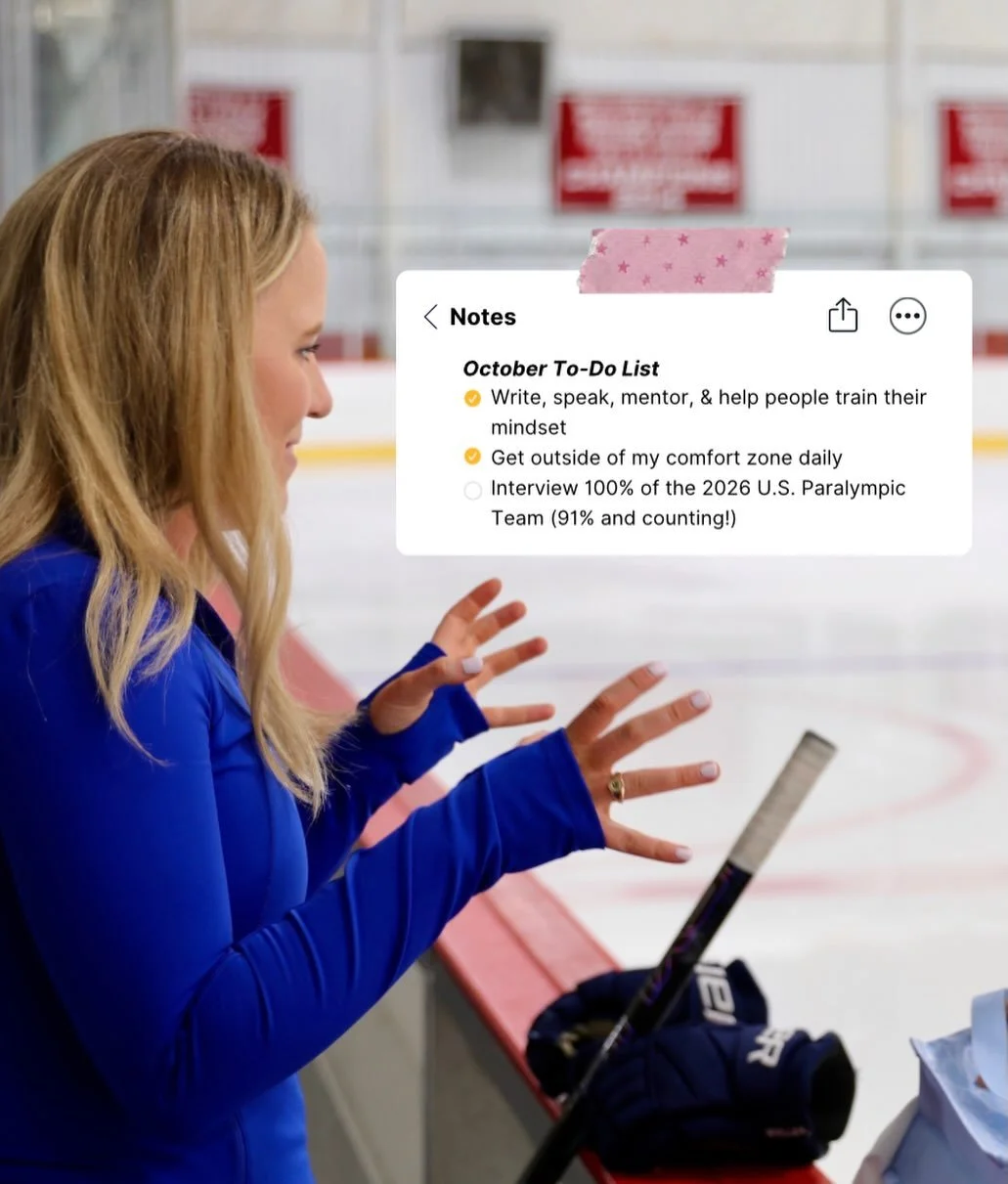
ABOUT THIS SERIES
I'm Amy Wotovich and I'm on a mission to personally interview 100% of the 2026 U.S. Olympic and Paralympic Team. How do elite athletes train their mindset, overcome failure, sustain dominance, and compete with confidence? Follow the journey to find out as Laura Dwyer is one of 304 athletes sharing their unfiltered answers.
