
Mike Schultz Lost His Leg. Then Built the Equipment That Changed the Sport.
In 2008, Mike Schultz was racing snowmobiles when his life changed in an instant. A crash cost him his leg. What came next, he says, was less about acceptance and more about problem-solving.
"I couldn't find proper prosthetic equipment to get me back into riding motocross and snowmobile racing."
So he did what makers do. He went to his shop.
"I'm a creator, I'm a maker. I love to draw prints and go out to my shop and make parts and have this finished product in my hand that I get to go test out, whatever it is. With my injury and the prosthetic options at the time, it was a natural fit with all the experiences that I've learned up to that point. I was kind of the perfect guy to create BioDapt.”
Just months after his injury, Schultz had built his first prototype.
"I was very motivated to make something that worked well because I didn't want to give up the sports that I love most.”
That prototype became BioDapt, Schultz’s prosthetic manufacturing company now used by adaptive athletes across the globe. The company officially launched in 2010 to help other amputees similarly achieve their goals.
Schultz started attending adaptive sporting events: mountain biking, motocross, various other action sports. In due time, something clicked.
"I realized that there were many others that could utilize the equipment. So I thought, you know what? I'm not gonna be a professional athlete anymore. I'm gonna see where this goes, because many people could utilize it."
You Can’t Predict Pivots
Then, a military veteran reached out who snowboarded at the time on a different prosthetic. He wanted to try Schultz's prosthetic on the mountain. There was just one problem.
“I did not snowboard. I did not know if it would work or not. But, I thought it would. So I learned how to snowboard in 2010. And that opened the door for me getting involved in snowboarding.”
That message — and Schultz's willingness to learn something brand new — opened the door to working with Walter Reed, Brooke Army Medical Center, and eventually, visibility on the Paralympic stage.
Today, BioDapt supports approximately 90% of lower-limb amputee athletes globally competing in Para Snowboard World Cup events and other international competitions. The entire U.S. Paralympic snowboarding team in the LL-1 and LL-2 classes uses his company's prosthetic knee (Moto Knee) and foot (Versa Foot).
Snowboarding didn't just become BioDapt's biggest use case. It became Schultz's next chapter as an athlete.
“A coach reached out and said, 'Hey Mike, you wanna go for it? We think you could be a contender in four years from now.' So I took a leap of faith and I haven't stopped."
Schultz joined the Toyota U.S. Para Snowboard Team in 2015. His illustrious career includes a gold, two silvers, and a bronze across three Paralympic Games. .
The Founder's Mindset on the Mountain
Ask Mike Schultz what kept him competing for 12 years, in Pyeongchang, Beijing, and Italy, and he immediately talks about the process.
"It's not about trying to win, necessarily. That's not what I set my goals around. I don't set my goals around winning medals. I love the challenge of progression."
That framework of incremental improvement is the same one he runs his company by. In Schultz's world, sport and business are very similar universes.
"Sports and business are very much alike. It's just not the physical side of it, but the mindset and problem solving. We set goals as athletes, long-term and short-term, and then build a pathway to get to that point. It's very much like that in business."
The difference? In running your own company, there’s no playbook.
"In the business side, I had no idea what I was doing. I was just learning as I was going. So for a while, it was just slow, step-by-step. Creating the product and then figuring out all the details of marketing and connecting with customers. Finding vendors and part suppliers, communication routes with medical clinics, the list goes on.”
He learned it all on the fly. The same way he learned to snowboard.
End of an Era
Schultz announced prior to Milano Cortina that he would be retiring after the 2026 Games. Knowing it was his last, he said, allowed him to soak it all in and embrace each moment. In Schultz’s last competitive race, he raced to bronze in banked slalom.
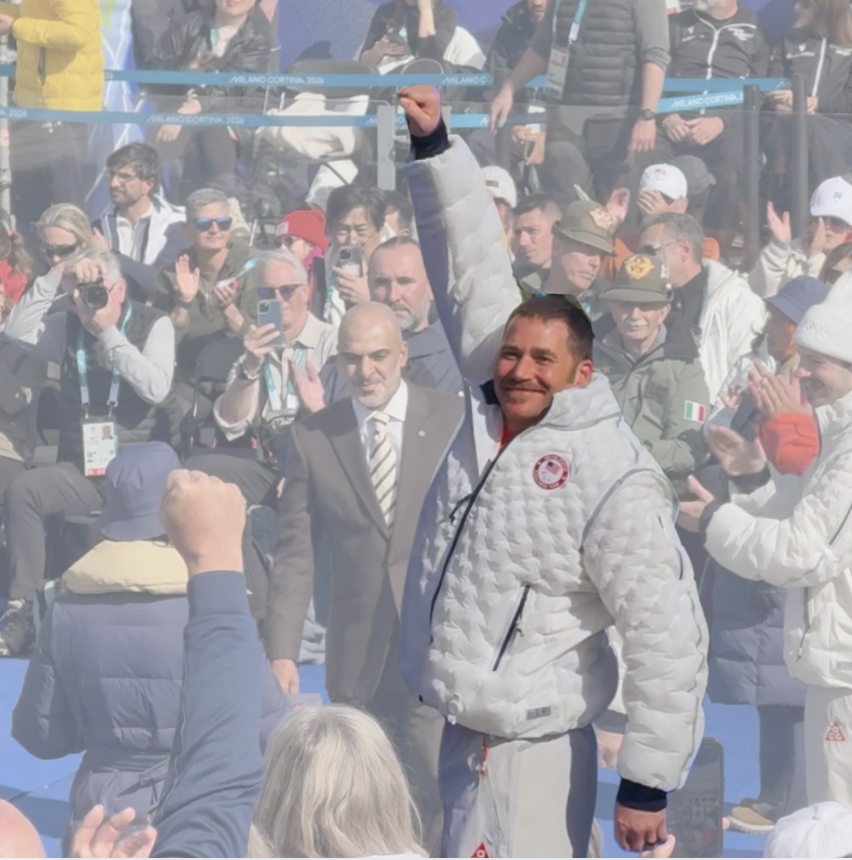
“It's certainly hard to keep up with the field year after year after year. I call them kids, I mean, the average age now is probably mid to late 20s — but they're kids compared to me. And they're constantly pushing me outside my comfort zone.”
Photo Credit: Amy Wotovich / Back The Team
The sport nowadays looks nothing like the one he entered. When he joined, a minute-long course separated the two lower-limb classes by over ten seconds. Now?
"Looking at our class, LL1, compared to LL2 when we first started — for example, on a minute-long course, there'd be a gap of 10, 11, 12 seconds from the podium in LL1 to the podium in LL2. And now it's within the same second sometimes, in Banked Slalom. And we've been down to tenths and hundredths of seconds in the top six positions. So it's tight."
He helped build that. On the hill and in his shop.
"Team U.S.A. and Para Snowboard has been such a huge part of my life for 12 years. I wouldn't trade it for nothing. There's lots of ups and downs through my career, but overall, being part of that team and the people within it — that's the highlight. I'm gonna miss that the most."
Three Games. Four Paralympic medals. Ninety percent of the field competing in BioDapt equipment. And now a drawing board full of new ideas that finally get his full attention.

ABOUT THIS SERIES
I'm Amy Wotovich and I am on a mission to interview 100% of Team USA's 2026 Olympic and Paralympic athletes to create the most comprehensive mindset record of a single Games cycle. What do elite competitors actually believe about pressure, identity, failure, and joy? Mike Schultz is one of hundreds of athletes sharing their unfiltered answers. Follow the journey!
