
Inside the Mentality That Paralympian Sean O'Neill Brings to the Ice, the Courtroom, and to Life.
When Sean O'Neill talks about confidence, he does so with a laugh. "Generally, I need to tamp my confidence down, to be honest." This is a window into how a wheelchair curler, a practicing lawyer, and lifelong Cape Codder shows up to the biggest ice of his life: prepared, grounded, and a little amused at his own certainty.
Training The Mind
Curling's reputation as chess on ice isn't lost on O'Neill. Where other Team USA squads travel with a nutritionist or physical therapist, curling is different. "We always travel with our sports psych," he says. "We spend a lot of time on the mental aspect of the game. It’s a huge focus area for us."
Over the past year, a central theme for the U.S. mixed wheelchair curling team was practicing under pressure. Manufacturing scenarios to make training feel like competition before the competition day arrives.
"Trying to add stakes into practice, trying to make sure we're always practicing with focus and a plan and having that mindset of…practice like we play to welcome the pressure."
O’Neill reflects on how a significant part of training your mindset is understanding not just how you respond to pressure, but how your teammates beside you do too.
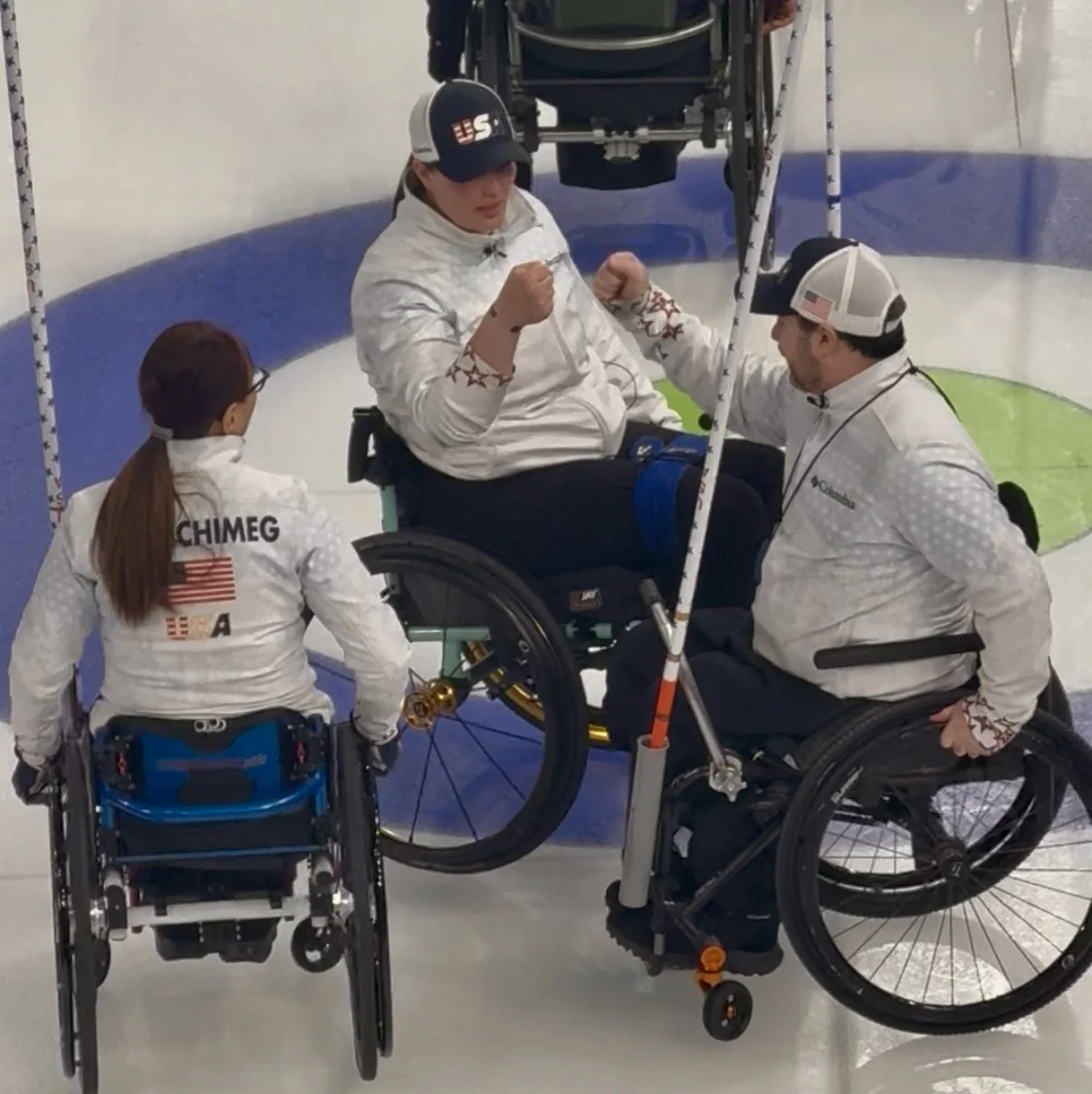
The example he gives is telling: "If Katie misses a shot, she does not want me to come up and say 'it's all good.' She'll be like, no, it's really not. Whereas for me, if I miss a shot, I do want a teammate to be like, hey, we got you."
Image Credit: Amy Wotovich, Back The Team
"Understanding that, and what brings out the best in people," he says, "is a huge part of curling and a huge part of our success as a team."
A Debut, and a Disposition
Everyone around O'Neill braced him for the magnitude of his Paralympic debut. He listened, nodded, and quietly disagreed.
"People told me: everything is going to be different, making your Paralympics debut, it's going to feel different, it will be harder, the whole nine yards. And I would be like... yeah, I agree with that, but I also do not mind being the center of attention. I think I'll be fine."
He was. His work with their team's sports psychologist helped: "competing in Cortina did feel very normal to me, it was an energy I could feed off."
Still, O'Neill doesn't take the debut lightly in hindsight. He holds the experience with a deep level of gratitude.
"We're all Paralympians, we're all disabled athletes, we all have something that changed our lives drastically in a moment, at some point. We know that the future is not given. And hopefully have all made the most of our debuts, of the experiences, however many we get."
Lessons On and Off the Ice
O'Neill is a graduate of Harvard Law School and a practicing attorney. The sport and the profession might seem like separate tracks, but he sees them as deeply connected, starting with the way curling sharpens strategic thinking.
"I’m planning moves, planning legal strategies, planning life multiple steps ahead. Trying to anticipate in that sort of game theory way: if I do this, they do this, I do this. Curling has certainly contributed to approaching situations with that thinking."
And then there's what he calls the spirit of curling. Curling is self-refereed. You are expected to hold yourself accountable, whether or not anyone else is watching.
"In curling, you must be your best self, even when nobody's watching. Hold yourself to high standards. And then that idea of welcoming inclusion, bringing everybody in, that's something we all can use in daily life."
O'Neill carries this standard of excellence well beyond the ice.


ABOUT THIS SERIES
I'm Amy Wotovich and I am on a mission to interview 100% of Team USA's 2026 Olympic and Paralympic athletes to create the most comprehensive mindset record of a single Games cycle. What do elite competitors actually believe about pressure, identity, failure, and joy? Sean O’Neill is one of hundreds of athletes sharing their unfiltered answers. Follow the journey!
