
What 200+ interviews with America's Olympians and Paralympians are revealing about the surprising role of failure in mental performance.
—
What if the very thing holding you back is also one of the most powerful ways to move forward?
I've personally interviewed more than 200 members of the 2026 U.S. Olympic and Paralympic Team to investigate a question I've been fascinated by since my own days competing as a springboard diver at Harvard:
How do the world's best athletes learn to act effectively when their own minds are working against them?
I've developed a framework examining three dimensions of mental performance to identify recurring patterns in how elite athletes develop mental performance skills.
The obstacles: What gets in way? These are thoughts, emotions, and circumstances that interfere with effective action.
The strategies: What do Olympians and Paralympians actually do to navigate mental obstacles? These are the specific skills and behaviors used to respond.
The development: How do Olympians and Paralympians acquire, test, and refine mental strategies to improve their mindset overtime?
I’ve uncovered an interesting paradox in my research. Failure is both the problem and the solution.
Let me explain.
The Paradox of Failure
In my ongoing analysis, fear of failure is the #3 most frequently identified mental obstacle. Yet, experiencing failure-related setbacks is the #1 most frequently identified pathway to developing a strong mindset.
Again and again, athletes describe a disappointing performance, an injury, a missed qualification, or consequential mistake as the moment that became a lasting opportunity to build mental toughness.
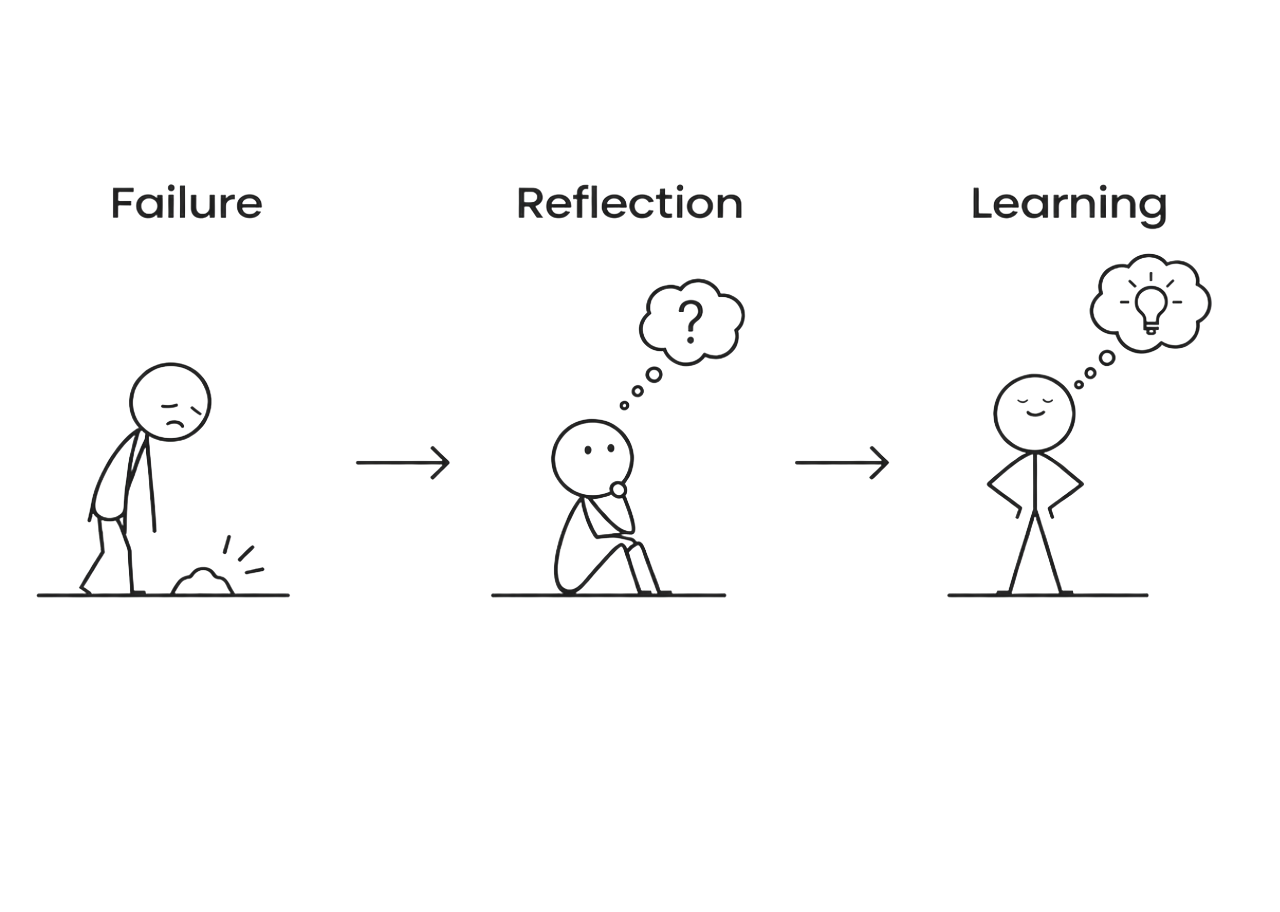
The very thing athletes are afraid of experiencing is also what they most frequently identify as a turning point in learning to train their minds.
Ironic, right?
Failure is both one of the greatest obstacles to mental performance and one of the greatest opportunities to develop it.
But here's the catch. Failure doesn't automatically build confidence, resilience, or mental toughness. If it did, we'd all emerge from our most difficult experiences stronger. But that's not always what happens.
Some setbacks leave us more fearful, less confident, and less willing to try again. Others fundamentally change how we approach challenges.
So what happens in the grey area between failing and growing?
To investigate, I analyzed athlete interviews passage by passage, identifying moments when athletes described a meaningful shift in their approach to mental performance. Then I examined what else appeared in those same accounts.
One pattern caught my attention.
Of the 96 athletes who described a turning point in their mental development, 41 (43%) also referenced seeking or using support within those same accounts.
These weren't simply mentions of supportive people elsewhere in their interviews. In many cases, support appeared in the very story athletes told about how their thinking changed.
—
Consider Paralympic snowboarder Keith Gabel. After finishing seventh at the 2022 Beijing Paralympics, Gabel was heartbroken. He had spent years competing at the highest level and was considering retirement.
While texting his wife about his disappointment, she responded with five words: "Looks like we're going to Italy."
Gabel described that exchange as the beginning of a domino effect. Rather than walking away, he committed to another Paralympic cycle. In his ‘failure’ grey area, Her words helped him find a solution.
—
For speed skater Sarah Warren, support played a different role. Growing up, Warren believed failure wasn't an option. Then she tore her ACL and underwent multiple knee surgeries. Suddenly, the athlete who rarely had to confront failure was forced to figure out how to respond to it.
Her brother, who had experienced a similar injury, provided guidance to replace her fear of failure with a more deliberate response: examining what went wrong and identifying what she could learn.
Today, Warren doesn't pretend failure feels good. As she put it, "an iPad's coming out and I'm learning from it."
For Gabel, support helped him reconsider his future. For Warren, it helped her reconsider her response.
Your Takeaway
Failure can be one of our greatest psychological obstacles. Yet it can also become one of our greatest opportunities to develop mental toughness. We so frequently hear that we must embrace failure, get comfortable being uncomfortable, and see setbacks as opportunities.
Good advice, but incomplete instructions.
“Embrace failure” stops being helpful the moment you’re packing up your equipment, shaking hands with the competitor who just beat you, and walking away knowing they’re about to live the dream you’ve spent years chasing while your clock resets.
Because failure on its own is just an experience. Learning from it is a skill.
My research with the 2026 U.S. Olympic and Paralympic Team reveals that the gray area between failure as a problem and failure as a solution isn’t a space that elite performers navigate alone.
So, who’s in your corner?



Amy Wotovich is a Harvard graduate, former NCAA springboard diver, TEDx speaker, and founder of Back The Team. She speaks, writes, and researches mental performance and neuroplasticity, reaching more than 1.2 million people annually. Through keynote speaking, workshops, and 1:1 coaching, Amy helps individuals, teams, schools, and organizations move beyond knowing mindset matters to understanding how to train it.
Learn more at backtheteam.org and connect with Amy on social media @amywotovich.
